
How to use co-routines with FreeRTOS

Overview
In the earlier post, I was able to use a static memory allocation with MSP430 and FreeRTOS. Even though that helped me to implement necessary support for a low resource MCU like MSP430FR5739, there is one more option how to optimize memory usage. Co-routines were originally developed to be used with a small embedded devices. Those are conceptually the same as tasks but have some key differences to save memory. The most important one is that all the co-routines share a single stack. Co-routines are not in active development anymore but according to the documentation, there are no plans to remove those either. Co-routines should help me with the small memory size by having a shared single stack with the multiple tasks.
Implementation
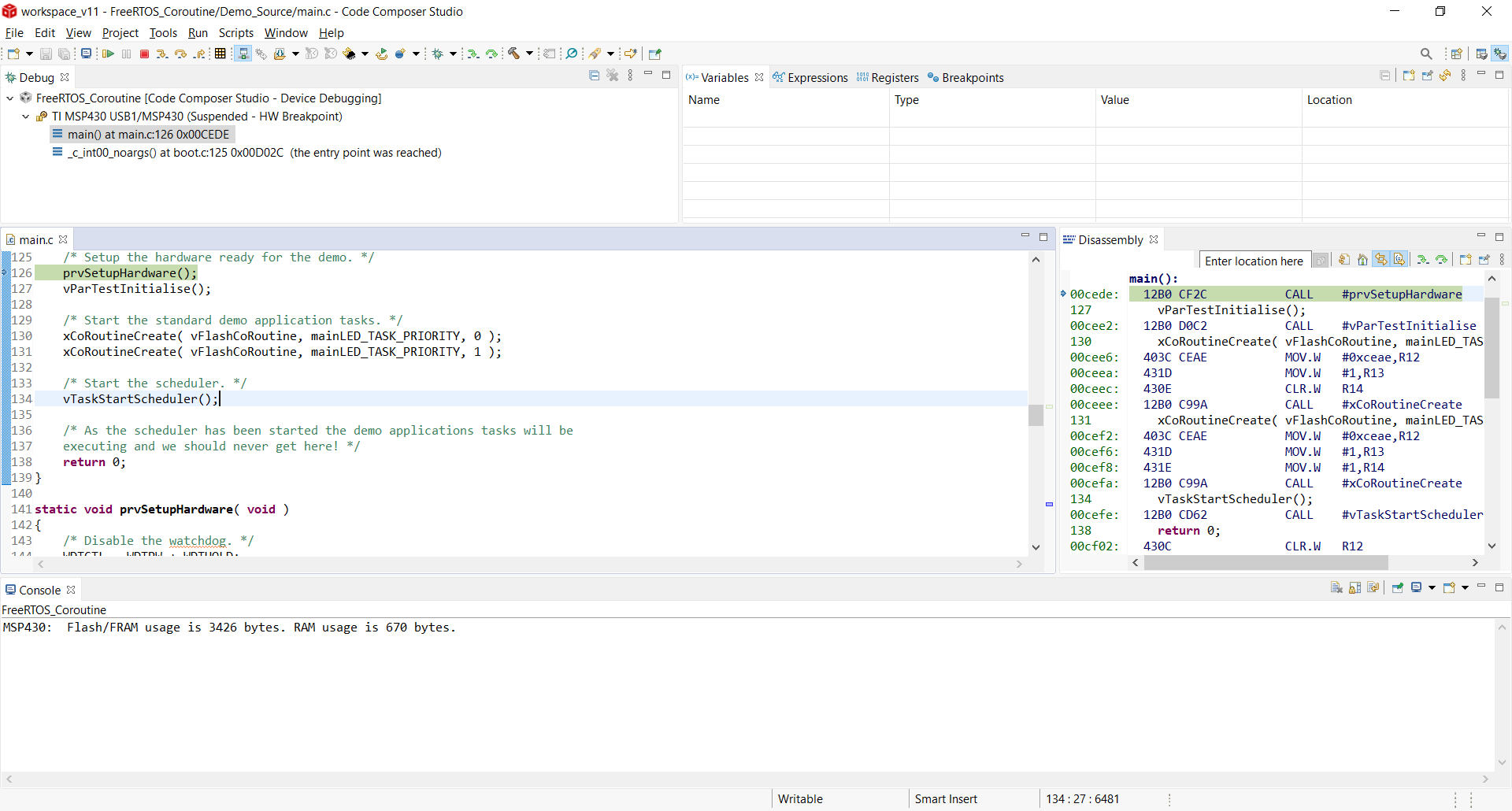
Co-routines are implemented by declaring a specific function and created by calling xCoRoutineCreate giving declared function as a parameter. I took the one co-routine from the documentation example which toggles the LED as I don't have anything else the code would do. configUSE_CO_ROUTINES must be defined in FreeRTOSConfig.h to be able to use functions to create and schedule co-routines. I added croutine.c file to my CCS project and placed a call to vCoRoutineSchedule function to my idle task hook to schedule my co-routines. Finally I added xCoRoutineCreate call to main to create my co-routine for the LED flashing.
Testing the modifications
After I tried to build the demo it was obvious that I was still missing something. I had a problem with the linking until I realized that I would need to enable a heap for this project as it creates a co-routine control blocks from the heap. As I was using my static memory allocation project as a basis for this, it was missing heap_1.c file and appropriate configuration from FreeRTOSConfig.h header. After restoring these I was able to try out the code with hardware.
Conclusion
So, having 2 co-routines and 1 task (idle) used 670 bytes. As I had only few co-routines, the benefit of using co-routines was not so obvious. Having tens of co-routines would demonstrate the benefit better. Also, I had to again manually adjust the heap size to avoid losing all the saved memory bytes to the heap. This wasn’t something I wanted to do. Apparently, co-routines cannot be used along static memory allocation or I did not just know how to do that.